
Chem 112L
Biophysical and Bioanalytical Laboratory

|
Chem 112L |
|
Dr. Kalju Kahn
Office: PSB-N 2623
Office hours: Fri 11:00-12:00 AM, "Open Door" policy other times
Phone: 893-6157
E-mail: kalju@chem.ucsb.edu
Website: http://www.chem.ucsb.edu/~kalju
MW2:		(@chem.ucsb.edu)
		Office hours:  	Chem 1317	TBA		Phone: x5468
TR6:	 	(@chem.ucsb.edu)
		Office hours:	Chem 1317	TBA		Phone: x5468
Chem 112L is an undergraduate laboratory course where students use advanced instrumental techniques to study the structure and function of biological molecules. Students will work on seven projects and learn to use techniques such as circular dichroism, nuclear magnetic resonance spectroscopy, biological mass spectrometry, differential UV spectrophotometry, protein crystallography, and computational biochemistry.
      Lab section 1: Mon 2:00-5:50; Wed 2:00-5:50;
      Lab section 2: Tue 6:00-9:50; Thu 6:00-9:50;

      Lab sections are in PSB-N 2619 or Chem 1153 (SGI lab)
| Syllabus | General information about the course. | |
| Cover | Cover page and Table of Content for the Lab Manual | |
| Textbook 1 |
"Thermodynamics and Kinetics for the Biological Sciences " by G. Hammes (2000)
This is excellent easy reading, offers adequate coverage of several topics. |
$47 Amazon |
| Textbook 2 |
"Physical Biochemistry: Principles and Applications" by D. Sheehan (2000)
Your Chem112 textbook. Good coverage of experimental methods. |
$67 Amazon |
| Textbook 3 |
"Principles of Physical Biochemistry" by Kensal van Holde et al (2005 or 1998)
For students who prefer mathematical/quantum mechanical approach. |
$119 Amazon |
| History | Course website for Chem 112L (Spring 2006) | Link |
| Exams | How to prepare for the first midterm | |
| Exams | How to prepare for the second midterm | |
| Exams | Sample Questions for Midterm 1 | |
| Exams | Sample Questions for Midterm 2 | |
| Exams | Midterm 1 Key (Spring 2006) | |
| Poster: | Poster Presentation Guidelines | Link |
Students in the class do not have to purchase the laboratory manual. Each chapter of the lab manual can be downloaded here in the PDF format. Please note that you can follow hyperlinks that are in the PDF files by clicking on the link.
Data files, instrument manuals, and selected lectures notes to support the course are available below
| Supporting | Support materials PDF format. Download Adobe Acrobat Here | Acrobat |
| Multiple | Data analysis (Tutorial, PC Lab Access ...) | |
| Multiple | General Introduction to Mathematica | PDF NB |
| Multiple | Simulation and Least-Squares Fitting with Mathematica | PDF NB |
| Exp 1: | "Synchrotron radiation circular dichroism spectroscopy of proteins ..." | |
| Exp 2: | "Induction of a Remarkable Conformational Change in a Human Telomeric Sequence ... " | |
| Exp 3: | Mass Spectrometry Lecture by Dr. Pavlovich (2005) | |
| Exp 3: | "Electrospray: Principles and Practice" by Simon Gaskell | |
| Exp 3: | "Using Mass Spectrometry for Proteins" by Martha M. Vestling | |
| Exp 3: | "Principles of FT-ICR and its Application to Structural Biology" by Barrow et. al. | |
| Exp 3: | "Proteomic Tools For Quantitation By Mass Spectrometry " by Jennie Lill | |
| Exp 3: | Mass Spectrometry Data Tables | |
| Exp 3: | Mass Spectra Figures 1-3 | |
| Exp 3: | Mass Spectra Figures A-F | |
| Exp 4-1: | Conformational Complexity of Succinic Acid ... (Price, Roberts, Jorgensen) | |
| Exp 4-1: | Molecular Mechanics (NIH Guide to Molecular Modeling) | Link |
| Exp 4-1: | Quantum Harmonic Oscillator (using Mathematica) | Link |
| Exp 1-1: | Conformational Energy Searching (NIH Guide to Molecular Modeling) | Link |
| Exp 4-2: | Pathways to a Protein Folding Intermediate... (Duan and Kollman) | |
| Exp 4-2: | Introduction to Monte Carlo Method (UCSB) | Link |
| Exp 4-2: | Molecular Dynamics Simulations (NIH Guide to Molecular Modeling) | Link |
| Exp 4-2: | Molecular Dynamics (Primer by Furio Ercolessi, University of Udine, Italy) | Link |
| Exp 1-2: | BOSS User Manual (Jorgensen Research Group at Yale) | Link |
| Exp 4-3: | NMR Lecture Notes | |
| Exp 4-3: | Conformational analysis of allantoin: NMR Instrument Manual | |
| Exp 4-3: | "Structure Determination of Biological Macromolecules in Solution Using NMR Spectroscopy" by Gerhard Wider | |
| Exp 3: | Protein Mass Spectrometry: Grading Rubric | |
| Exp 5: | "Understanding Enzyme Inhibition" by Raymond Ochs | |
| Exp 5: | Enzyme Kinetics: Grading Rubric | |
| Exp 6: | Protein Crystallography: Grading Rubric | |
| Exp 6: | Crystallograpgy 101 by Bernhard Rupp at LLNL | Link |
| Exp 6: | Crystallograpgy 101 by Bernhard Rupp at LLNL | Link |
| Exp 6: | "High-resolution neutron protein crystallography ..." |
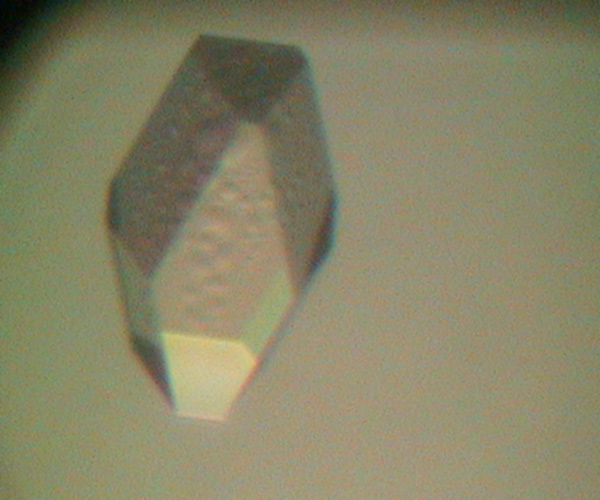
One of the experiments in the Biophysical and Bioanalytical Chemistry Laboratory at UCSB is dedicated to protein crystallography and X-ray diffraction. On the first day, students determine the best conditions for growing lyzozyme crystals via hanging drop crystallization trials. Some of the crystals obtained by students are shown below.



| |
|
On the following day, crystals were examined and diffraction data was collected on our in-house X-ray diffractiometer. Many students obtained crystals that were large enough for collecting good-quality diffraction data. Some of our best crystals diffracted down to 2.4 Angstroms, which is an acceptable resolution in modern macromolecular crystallography.


On the last day, students analyzed diffraction data to determine the unit cell characteristics and build a partial protein structure into the electron density map. We thank UCSB's Instructional Development Program for funding the development of this experiment; Dr. Alwyn Jones from Uppsala for providing copies of the program "O", and our gradute student Scott Hauenstein from the Perona group for heping implement this experiment.


Electronic Journals
Protein Data Bank
Grace: Data Analysis Program
PyMOL Molecular Visualization Program
Spectroscopy Online Resources
Protein Prospector: Proteomics Mass Spectrometry Database
Introduction to Macromolecular Simulation by NIH
UCSB General Catalog
UCSB Campus Map
UCSB Gold Login
UCSB Umail Access
UCSB Environmental Health and Safety